- Suresh Kumar
- 06-01-2026
- 0 Comments
Dance of Andaman and Nicobar Islands: A Complete Guide to the Islands’ Rich Cultural Heritage
Being a hub of cultural heritage, the dance of Andaman and Nicobar Islands is as mesmerising to everyone as the island’s waves.
The Andaman and Nicobar Islands have a unique relationship with dance as it is more than a mere source of entertainment; it is the very breath that keeps the civilisation alive, which has been the case for centuries.
The movements are the passage to a place where, for example, the sacred Ossuary Feast of the Nicobarese or the storytelling dances of the Great Andamanese are looked at as just tales; they are the description of a world that integrates nature and spirit.
Come with us on this trip through the green isles to discover the colourful, musical, and highly religious heritage of the traditional dance of Andaman and Nicobar Islands.
Dance of Andaman and Nicobar Islands — The Nicobarese Tribal Dance
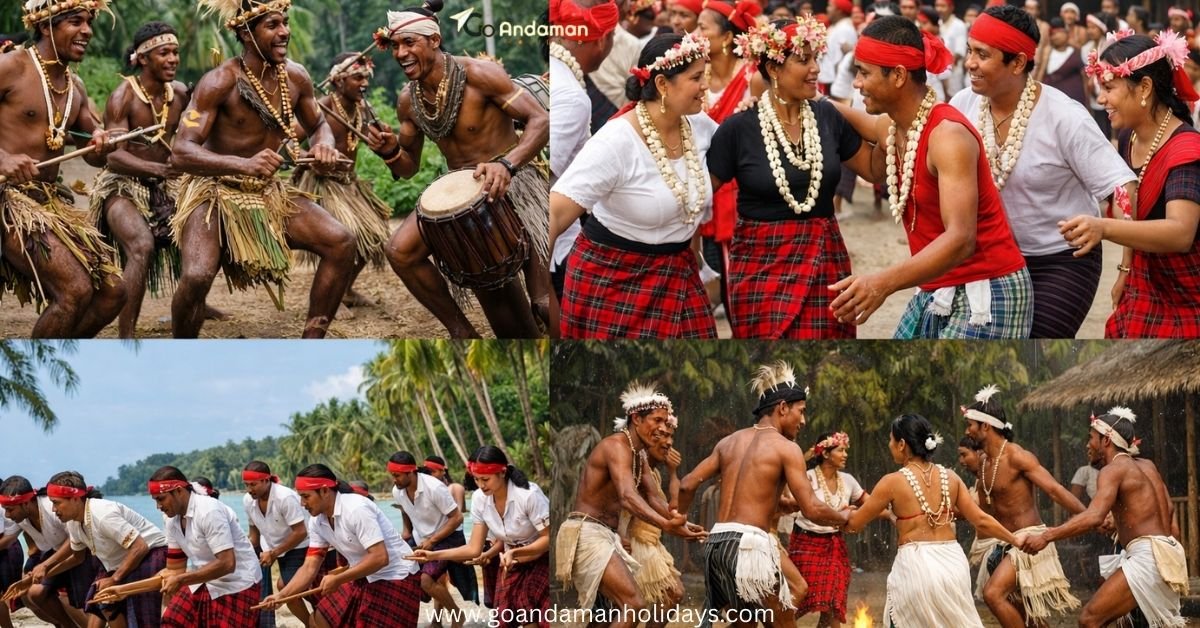
The Nicobarese have a dance of Andaman and Nicobar Islands that is an ode to the vocal rhythm and the synchronised movements.
The Context of Celebration
The dance is at its best during the Ossuary Feast, better known as the Pig Festival. The Nicobarese community, who predominantly live in Car Nicobar, have a dance that is very much social and a thing of the past.
Unlike many Indian folk dances that are accompanied by heavy percussion, the Nicobarese dance is an ode to the vocal rhythm and the synchronised movements.
The Formation
The dancers put their arms over the shoulders or lay their hands on each other’s shoulders and form a large circle that is not broken at all. They perform together and their movements are in rhythm with each other, stepping forward and backwards as if they were the waves of the Bay of Bengal coming in and going out.
Acoustic Purity
One of the most fascinating aspects is probably the nonexistence of musical instruments. The performers producing sound on the stage by their loud, rhythmic foot stomping and monophonic, melodic singing, which is basically the same as creating a natural percussion that ripples through the coastal air, are the dancers themselves.
The Great Storytelling of the Dances of Andaman and Nicobar Islands
The dances of Andaman and Nicobar Islands carry what words cannot express for the Great Andamanese. Without any written records, stories are passed down through gestures, steps, rhythms, each movement holding memory alive. Dancing like scenes from a play, each move unfolds adventure at sea like storm waves.
Narrative Themes
One moment shows hunters spotting a dugong; the next, their spears find mark. Then comes a figure from long ago, stepping forward through rhythm, proving courage never fades.
The "Duggi" Dance
It quiets down when the dancers begin, bodies leaning like waves, arms carving circles through the air. Their steps drag across sand, mirroring how Duggi hauls itself ashore under moonlight. Each motion recalls a journey between water and earth, passed down without words.
Balance shifts low, hands ripple forward. Not fast and never rushed. This is not just a spectacle; it lives on as a memory. Sea wind meets bent backs, timing each sway. They move because the ocean gives, because rhythm returns what was taken.
The Sounding Board
From somewhere beneath, rhythm rises. The p? kuta yem nga, a carved wooden platform, gives sound when struck. Not hands but feet make it speak. Each thump shapes a low pulse, steady like breath. Voices circle around the beat. Dancers move inside that sound, guided by its depth.
For couples who want more than just sunsets and resorts, exploring the cultural rhythm of the islands adds depth to every journey. Many Andaman honeymoon packages today include heritage walks, festival visits, and local performances, quiet moments where stories unfold through movement rather than words.
Sacred Circles: The Ritualistic Dances of the Onge and Jarawa
The Onge and Jarawa tribes have always lived in the most secluded areas and their dances are among the fewest in the world that have not been altered at all.
The Onge "Pilo" Dance
This dance is sometimes performed when seasons change or when young men are initiated into adulthood. The dancers take low crouches then leap around all of a sudden and at the same time, they make vocal calls which are like the sounds of the jungle.
Jarawa Community Spirit
Jarawa dances are full of spontaneous joy. They mostly consist of simple circle formations where people clap hands vigorously and chant repeatedly. These are usually done on occasions like a hunt's success or a newborn's arrival.
Spiritual Connection
It is through dance that the two tribes get to talk to Puluga (the ultimate god) and the spirits of the forest. When the dancers are tired, it is said to be because the spirit has been purified.
Beyond the Tribes: The Influence of Settler Communities
The Andaman and Nicobar Islands carry echoes of many regions. Because of this mix, traditions blend in quiet, everyday ways.
Bengali and Tamil Traditions
Spring festivals now bloom in new places, thanks to Tamil communities who carry forward the Kavadi Attam, a rhythmic offering tied to Lord Murugan. Meanwhile, echoes of Basanta Utsav rise where Bengalis gather, their voices weaving stories through folk tunes that greet warmer days.
The Karen Bamboo Dance
This dance flows through narrow spaces made by bamboo sticks. Hitting together fast, the poles frame each move done by skilled performers from the Karen people. These people once lived in what is now Myanmar.
Instruments & Adornments Used in the Dance of Andaman and Nicobar Islands
All the ornaments and musical instruments for the dance of Andaman and Nicobar Islands are made from materials that have been gathered from the sea or the forest.
Natural Instruments
In addition to the sounding board, you would see bamboo flutes, shell whistles, and the Katchal (castanets made from smooth wood) that emit a clear, rhythmic click.
Body Art as Costume
For the dress of Andaman and Nicobar Islands, dancers have turned to nature for their dressing by using Ocha (white clay) and red ochre to paint their bodies. The designs look like animal skins or forest vines.
Adornments
The headdresses are made of bird feathers (like the megapode); meanwhile, the necklaces and waistbands are composed of dentalium shells and bark fibres.
Experiencing the Rhythm: Festivals for the Modern Traveller
Even though access is limited to safeguard native communities, cultural gatherings let visitors observe the folk dance of Andaman and Nicobar Islands with respect.
Island Tourism Festival (ITF)
Every January in Port Blair, the Island Tourism Festival takes over for ten days. A broad mix of cultural acts from tribes and local communities fills one shared space. Performances unfold together, each distinct yet part of something larger.
Subhash Mela
Festival lights glow across Swaraj Dweep when Subhash Mela arrives. Music, dance, and storytelling fill the air with colour and rhythm. Each performance reflects a piece of life shaped by generations past.
Because access to many cultural spaces is regulated to protect native communities, planning matters. Choosing the best travel agent in Andaman can help improve your journey.
Frequently Asked Questions (FAQs)
Q1. What are the tribes of Andaman and Nicobar Islands?
Some native groups live on these islands, like the Great Andamanese, Jarawa, Onge, and Sentinelese among the Andamans. Over in the Nicobars, you’ll find the Nicobarese along with the Shompen people.
Q2. What is the dance culture of Andaman and Nicobar Islands?
The main dance of Andaman and Nicobar Islands is the Nicobari Dances (Nicobarese). Energetic movements that flow like water and rhythmic tapping. Voices rise together in chants. Instruments stay basic; rhythm comes from breath, clap, and voice.
Q3. What is the heritage of Andaman and Nicobar Islands?
Tribes have lived on the Andaman and Nicobar Islands since the Palaeolithic days. People came long, moving in from Bengal, Tamil Nadu, areas of Andhra Pradesh, and also from Myanmar. Many heritages sit side by side, distant in origin but linked somehow. This mix made visitors name the place "Mini India."
Q4. What is the traditional dress of Andaman and Nicobar?
Out on the islands, people once dressed using what nature provided: bark cloth, palm leaves, seashells, and even feathers. Over time, some islanders began adding store-bought clothes to their everyday wear. Meanwhile, those who moved there from mainland India often choose garments such as sarees and dhotis. The old ways mix quietly with new habits now.
Q5. Are travellers allowed to participate in the dance of Andaman and Nicobar Islands?
No, it’s off limits to outsiders. Still, moments exist where guests may step into shared traditions. Public shows at official gatherings, say the Island Tourism Festival, open doors a little wider. Watching is the norm; sometimes, an invitation for participation follows. Protection of culture shapes every rule made. Outsiders are allowed as long as they remain respectful.
Conclusion
The dance of Andaman and Nicobar Islands is not only a visual marvel, but also a tenacious heartbeat of the islanders that has withstood the test of time.
The transition from the silent and gentle movements of the Nicobari circle to the loud and sharp sound of a Great Andamanese's hunt-dance, these customs are our constant reminders of the rich, ancient bond of the earth with us. Watching these dances means witnessing the very essence of the islands.
So, are you ready to move past the beaches and immerse yourself in this vibrant cultural tapestry? Now is your chance to be a part of these traditions. Book our Andaman family tour packages and learn about India’s hidden heritage!
Learn More: Top Andaman and Nicobar Tourist Places to Visit: Beaches, Islands & Hidden Gems